
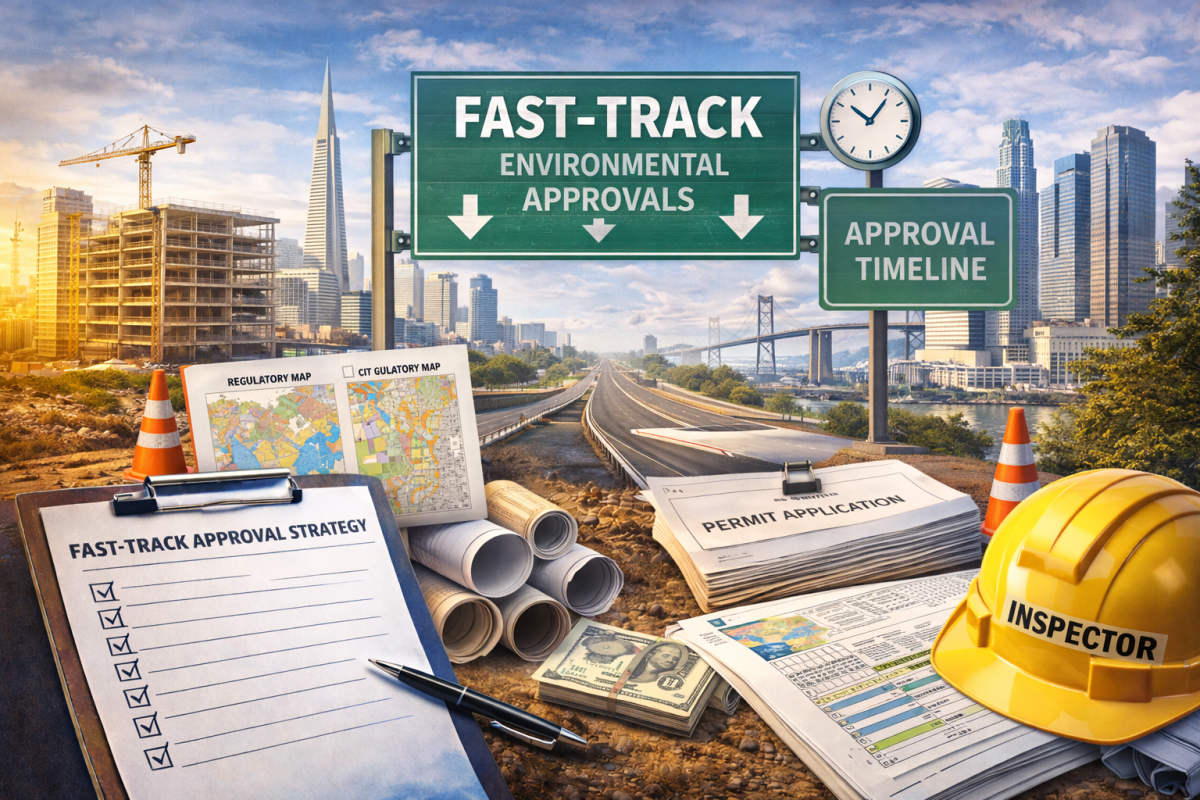
Environmental approvals don’t have to take 18 months.
Across California’s most competitive markets, developers are cutting approval timelines by 40–60% by using statutory fast-track pathways, grant-funded programs, and coordinated permitting strategies that most teams never explore.
Programs like SB 35, FAST-41, and EPA Brownfields have fundamentally changed how quickly projects can move from acquisition to groundbreaking. The problem isn’t regulation. It is simply that many projects aren’t structured to qualify for these accelerated pathways.
The difference between a stalled deal and a fast-moving one often comes down to decisions made before escrow closes: how site data is collected, how agencies are engaged, and which approval tracks are triggered early.
But you can take some practical, legal, and technical steps to fast-track environmental approvals for commercial projects without cutting corners on public safety or compliance. Below, we explain how approvals are speeding up, what tools and programs exist, and exactly how developers should structure projects.
Why 2025 Is Different: New Fast-Track Pathways California Developers Should Know
Environmental review used to be the biggest uncertainty for commercial projects because CEQA, NEPA, and agency reviews often stretched into long, unpredictable timelines. Today, that landscape is changing. California and federal agencies have introduced new fast-track pathways, especially for infill development, brownfield reuse, housing-supportive projects, infrastructure, and climate-aligned development.
These programs use objective eligibility criteria, so if a project meets specific checkboxes (like being on a previously developed site or contributing to policy goals), it can move through review much faster. Agencies are also assigning dedicated staff to priority projects, improving coordination and cutting delays.
Federal programs (such as IIJA, FAST-41, and EPA grant initiatives) are pushing agencies to adopt shorter, more predictable timelines. As a result, commercial developers benefit from faster approvals, reduced carrying costs, and more reliable scheduling.
In short:
Regulatory agencies are streamlining, digitizing, and prioritizing the right kinds of projects, making environmental approvals faster, clearer, and more predictable than ever.
Delays in environmental approvals can still turn profitable deals into burdensome ones, but the developers moving fastest today aren’t waiting passively for agencies to respond. They’re using California CEQA streamlining tools, SB 35 environmental review pathways, and brownfield fast-track programs to cut approval timelines dramatically.
10 Strategies to Cut Environmental Approval Time in Half
What follows isn’t theory. These are the exact approval strategies used on time-sensitive California deals where delays would have killed project economics.
1. Know the Fast-Track Options and When They Apply
There are several common fast-track mechanisms that experienced developers account for up front:
- Ministerial/streamlined approvals (e.g., SB 35 and similar statutes). For qualifying housing and infill projects, state law creates a ministerial approval path in many jurisdictions, meaning the project is reviewed only against objective standards and not subject to discretionary CEQA review in the same way. This can substantially shorten entitlement timelines when the project fits the criteria.
- Statutory or emergency CEQA suspensions or targeted waivers. In emergencies (wildfire recovery, declared disasters), the state has mechanisms to speed certain statewide approvals, and governors have occasionally used executive orders to temporarily limit or streamline environmental review for recovery efforts. These are fact-specific but important to watch.
- Federal fast-track tools for large infrastructure. Federal programs such as FAST-41 create coordinated permitting timelines and require interagency coordination for covered projects, which can speed federal reviews when a project meets program criteria.
- Brownfields & grant-enabled fast-tracking. EPA and state brownfields programs offer assessment and cleanup grants and technical assistance that can accelerate site characterization and remediation, often a gating item for permits. Recent rounds of federal brownfields funding have significantly increased available support.
Knowing which of these paths applies to your project is the first step to fast approval.
2. Get Regulatory Alignment Before You Buy
One of the single best ways to avoid entitlement delays is to identify the lead regulators and the applicable standard before you close escrow. A pre-acquisition regulatory review should answer: who is the lead agency for environmental review (city, county, RWQCB, DTSC, or federal agency), what cleanup standards will apply based on intended land use, and whether ministerial or streamlining paths are available.
If the site is a brownfield, contact the EPA/State brownfields coordinator and DTSC early. Grant or technical-assistance programs can sometimes be leveraged only if you engage them at the assessment stage.
In short, regulatory mapping at acquisition converts months of uncertainty into a clear path forward.
3. Match Project Vision With the Most Efficient Cleanup Standard
Regulators set cleanup goals based on intended land use. A commercial warehouse or industrial logistics center will generally have lower human exposure assumptions than a daycare or multifamily housing site, and remediation goals and mitigation obligations reflect that.
If your program allows flexibility in land use, structure your entitlement and remediation strategy so that the cleanup necessary for your preferred use is the most cost-effective and fastest to obtain. This is both a technical and a creative exercise, as developers who plan land use and remediation in parallel often avoid over-cleaning (and over-spending) and can speed agency sign-offs.
4. Prioritize Site Characterization: Faster, Better Data = Faster Decisions
A fast approval requires fast, defensible data. Invest in a targeted but thorough Phase I and Phase II program tailored to the project’s redevelopment footprint. Use time-saving approaches where appropriate:
- Rapid field screening and 3D contaminant mapping to focus lab efforts
- Parallel soil, vapor, and groundwater sampling where vapor intrusion is a concern
- Early stakeholder briefings that present the data and proposed cleanup approaches in plain language
The goal is to resolve the “unknowns” that cause regulators to ask for more studies. Good characterization reduces rounds of agency questions, which is where months get added to schedules.
5. Use Pre-Approved or Performance-Based Remedies When Possible
Many agencies have pre-approved remedy lists for common, well-understood contaminants (petroleum hydrocarbons, certain VOCs) or allow performance-based remedies where you commit to outcomes rather than prescriptive methods. Where appropriate, propose proven, low-impact remedies (such as in-situ treatment or targeted excavation) paired with monitoring commitments.
Agency staff are more likely to fast-track reviews when the remedy is familiar, has a clear success metric, and has been used on similar projects. Document the technology’s track record and monitoring plan up front to accelerate approvals.
6. Bundle Permits and Use a Coordinated Project Plan
Rather than seeking approvals sequentially, bundle related permits and request a coordinated review. For projects involving multiple agencies (city, county, RWQCB, DTSC, air district), request a single coordinated project plan and timeline.
Federally covered projects under programs like FAST-41 already require a coordinated plan; other projects can achieve similar results by asking agencies to adopt joint timelines and agreeing on shared submittal deadlines.
A single point of coordination (either your experienced consultant or a project manager) can shave weeks or months off approvals by ensuring documents and responses are delivered on a synchronized schedule. On complex sites, coordinated permitting alone has reduced review cycles by 30–45% by eliminating sequential agency comments.
7. Leverage Funding & Technical Assistance to Remove Barriers Fast
Use grant programs and technical assistance strategically. EPA and state brownfields funds can pay for Phase II work, remedial design, or even partial cleanup, removing the financial obstacle that often stalls permitting.
Many grants also come with technical support that helps create stronger submittals and faster agency acceptance. Keep an eye on federal and state funding announcements and apply early.
8. Build Agency Relationships. Don’t Treat Regulators as Roadblocks
Fast approvals are rarely won on paper alone. Early, transparent engagement with regulators matters. Host pre-submittal meetings, share your technical plans before formal filing, and be responsive to requests for clarification.
Agencies are often swamped, and they have to do a lot of work. When agencies understand you’ve already done the heavy technical lifting, they can focus on outcome-based review rather than discovery.
9. Anticipate and Neutralize Common Delay Triggers
Some common causes of months-long delays include: incomplete contamination delineation, vapor-intrusion uncertainties, missing disposal options for contaminated soil, and unaligned remediation standards across agencies.
Address these proactively: have disposal options pre-identified, include vapor testing where appropriate, and provide a remediation decision tree that shows minimum, mid-range, and maximum responses depending on what your data reveals.
When agencies see a clear decision path, approvals move faster.
10. Plan for Post-Approval Requirements from Day One
Fast approvals sometimes come with conditions: monitoring, institutional controls, engineering controls, or phased cleanup tied to occupancy. Anticipate those requirements in budgeting and construction phasing.
A fast approval that leaves you unprepared for post-occupancy monitoring or maintenance is a false economy. Include maintenance plans and funding strategies early, so you get approval and can implement obligations without operational surprise.
Regional Considerations for California Developers
Approval timelines and fast-track opportunities vary significantly by market:
Bay Area (San Francisco, Oakland, San Jose):
Strong infill incentives, active brownfield fast-tracks programs, and coordination with the San Francisco Bay Regional Water Quality Control Board and BCDC for waterfront sites. SB 35 is frequently used for housing-adjacent commercial and mixed-use projects.
Los Angeles & Southern California:
Robust EPA Region 9 brownfield funding, city-level priority development fast-track programs, and coordination with SCAQMD for air permitting on industrial and logistics projects.
San Diego:
Streamlined coastal permitting for qualifying projects, active military base reuse (BRAC) sites, and local brownfield initiatives supporting redevelopment near former defense facilities.
Central Valley:
Agricultural-to-commercial conversions and infill projects often qualify for expedited CEQA review when aligned with adopted general plan updates or regional economic development goals.
Understanding local regulatory culture and available programs can shave two to four months off approval timelines.
The Approval Timeline You Set Today Determines Your 2026 Project ROI
Fast approvals aren’t about cutting corners. They’re about designing projects that qualify for streamlined pathways, structuring data collection to eliminate agency questions, and coordinating reviews before formal submissions.
Developers who understand SB 35 environmental review, brownfield fast-track programs, and California development permits gain a real competitive edge in today’s market.
The difference between an 18-month approval and a 6-month approval often comes down to decisions made in the first 60 days, before escrow closes.
Download our Fast-Track Approval Planning Guide.
Schedule a pre-acquisition regulatory review: Contact PEnterprise
___________________________________________________________________________
[This guide is based on 15+ years of structuring environmental approval strategies for California developers operating in some of the state’s most regulated markets. It reflects real-world experience across 500+ commercial and mixed-use projects throughout the Bay Area, Los Angeles, San Diego, and the Central Valley.
PEnterprise is led by Pearl Hanks (MBA, Professional Geologist, Certified Hydrogeologist), combining deep technical expertise with transaction-level strategy to help developers shorten approval timelines, reduce regulatory risk, and protect project ROI.]
Related Articles:
Maximizing ROI Through Strategic Site Remediation
Environmental Due Diligence Checklist for Developers
Article by: Pearl Hanks, MBA, Professional Geologist, Certified Hydrogeologist | CEO, PEnterprise Consulting Services
Pearl leads environmental due diligence, remediation, and regulatory strategy for complex redevelopment projects across California. With 15+ years of experience, rare triple-certification, and oversight of 500+ site investigations and cleanups, she specializes in helping developers reduce risk, accelerate approvals, and transform contaminated properties into high-value assets.