Municipal infrastructure projects are failing environmental reviews at record rates.
California data shows nearly 40% of public works projects face environmental compliance delays, adding an average of $2.3M in costs and 14 months to project timelines. The cause is rarely stricter regulations. It is agencies discovering environmental risks too late in the planning process.
Forward-thinking agencies now embed environmental risk management at the earliest planning stages, identifying issues when solutions are faster, cheaper, and easier to implement.
This guide explains which environmental risks most often delay municipal projects, when in the planning cycle to address them, and how to structure risk management that protects budgets and schedules.
Why Environmental Risk Management Matters?
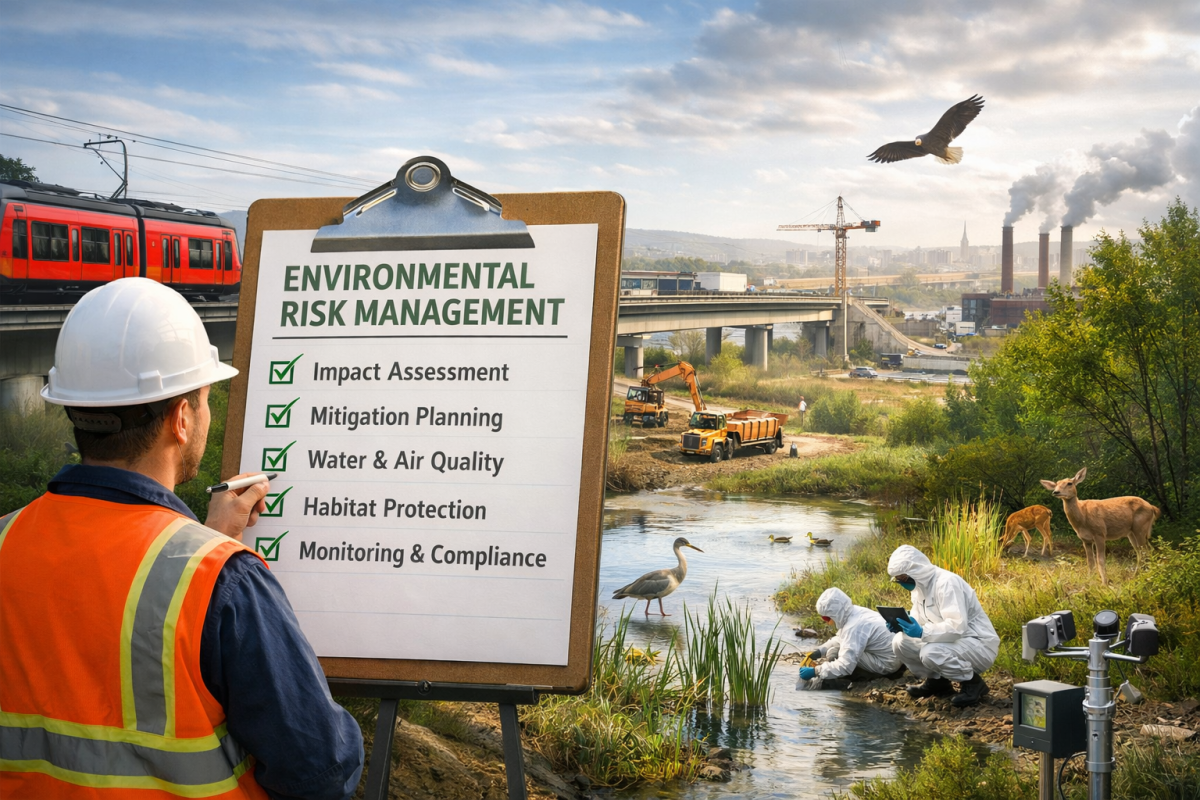
Infrastructure projects have far-reaching consequences that go beyond concrete, steel, and timelines:
- Such projects often require clearing land, modifying terrain, or interfering with natural water flows, which can disrupt ecosystems, degrade land, pollute water, and harm biodiversity.
- Construction activities, like heavy machinery, waste generation, emissions, dust, and noise, can directly affect air and water quality and the health and well-being of nearby communities.
- Once operational, infrastructure can change how communities use land and resources, influence water tables, and alter drainage patterns. This can potentially worsen flooding, reduce groundwater recharge, or degrade habitats over time.
Ignoring these impacts can lead not only to environmental damage, but also to public opposition, legal complications, delays, reputational risks, and, of course, failure to deliver truly sustainable development.
These risks are real, long-term, and often irreversible. Thus, environmental risk management must be central to every infrastructure planning cycle, from the earliest design sketches to long after project completion.
California Municipal Projects: Regulatory Framework
Public infrastructure projects in California operate within one of the most complex environmental regulatory environments in the country. It comes under intense public scrutiny, fixed budgets, and strict procurement rules.
CEQA (California Environmental Quality Act)
CEQA requires environmental review for most public projects in California and plays a central role in determining whether a project can move forward. It mandates that agencies identify potential environmental impacts, evaluate alternatives, and implement mitigation measures where significant effects are identified. Incomplete or poorly prepared documentation can create legal exposure, including lawsuits and permit challenges. As a result, CEQA compliance remains one of the most common causes of delays for municipal infrastructure projects.
Regional Water Quality Control Boards
Regional Water Quality Control Boards oversee construction stormwater permits, including the 1200-C permit, and regulate discharges that may impact local waterways. They enforce cleanup requirements when contaminated soil or groundwater is encountered and require monitoring, reporting, and mitigation to protect water quality. Early coordination with these boards is critical to avoid stop-work orders, redesigns, or costly compliance issues during construction.
Air Quality Management Districts
Air Quality Management Districts regulate dust, emissions, and air quality impacts associated with construction activities. They set requirements for equipment usage, vehicle emissions, and dust control measures to protect public health and nearby communities. Failure to comply can result in Notices of Violation, which can halt construction activities until corrective actions are implemented.
Department of Toxic Substances Control (DTSC)
DTSC regulates development on sensitive properties such as schools, parks, and public facilities, where stricter cleanup standards often apply. If contamination risks are not properly addressed, DTSC has the authority to block or delay development until appropriate investigation and remediation measures are completed.
Understanding these requirements at project conception prevents costly delays during construction.
What Agencies Should Know: Key Risks in Infrastructure Projects
Agencies need to be aware of a range of environmental risks, depending on context, type of project, and geography. Some of the most common include:
1. Soil Erosion and Sediment Runoff
When land is cleared for construction, removal of vegetation plus movement of earth can lead to erosion, which washes soil into nearby water bodies, disrupts aquatic ecosystems, and causes sediment pollution.
2. Water Pollution and Groundwater Contamination
Use of chemicals, fuel, concrete and construction-related waste can leach pollutants into surface water or seep into groundwater. Improper disposal of waste and lack of containment increase this risk.
3. Air Pollution and Dust
Heavy machinery, vehicle movement, excavation, and demolition can generate dust and emissions, affecting air quality, causing health risks to workers and nearby residents.
4. Noise and Community Disturbance
Construction noise and persistent work can disrupt local communities and wildlife, particularly in urban or densely populated areas.
5. Habitat Destruction and Biodiversity Loss
Infrastructure in or near forests, wetlands, rivers, or otherwise sensitive ecological zones can destroy habitats. This threatens flora and fauna, sometimes permanently.
6. Long-Term Ecological Stress and Resource Depletion
Infrastructure may strain local resources (water demand, land use), alter drainage, and change water tables. This can potentially reduce resilience, exacerbate floods or droughts, or degrade ecosystems over time.
Given this spread of risks across environmental, social, and regulatory dimensions, agencies must embed environmental risk management into every stage of their infrastructure projects.
Case Study: San Diego MTS Trolley Extension
The San Diego Metropolitan Transit System Blue Line Trolley extension faced multiple environmental risks including wetland impacts, contaminated soil from historical rail yards, and air quality concerns.
Environmental Risk Management Approach
The project applied a proactive environmental risk management strategy beginning with corridor-level environmental screening before the design phase. Early coordination was established with key regulatory stakeholders, including the U.S. Fish and Wildlife Service (USFWS), Regional Water Quality Control Board (RWQCB), and CEQA lead agencies to align permitting expectations and mitigation strategies. Contaminated soil investigations were completed prior to land acquisition to identify cleanup requirements early and avoid construction-phase surprises. Public engagement was also conducted to gather input on mitigation measures and evaluate design alternatives, ensuring community considerations were integrated into the planning process.
Results
- CEQA clearance achieved 8 months faster than similar transit projects
- No legal challenges or permitting delays
- Contamination addressed within the original project budget
- Project delivered on schedule
Early environmental planning prevented risks from becoming construction-phase delays.
Principles and Best Practices Agencies Should Follow
When agencies in California plan public infrastructure projects, there are well-established legal, environmental, and institutional frameworks that guide how environmental risk must be assessed and managed. Below are the principles and best practices:
1. Comply Early with CEQA and Treat Risk Assessment as a Core Step
In California, most public agency infrastructure projects must undergo environmental review under the California Environmental Quality Act (CEQA) before they can proceed.
This means agencies should:
- Identify whether the project is “discretionary” (requires agency approval or permits) and likely to cause direct or indirect environmental changes.
- Conduct an Initial Study, a preliminary screening to check for potential impacts, using baseline data on land use, water, air, ecology, biodiversity, community setting, and other environmental/socioeconomic parameters.
- If the Initial Study identifies significant potential impacts, prepare a full environmental review document, such as an Environmental Impact Report (EIR), or if impacts can be mitigated, a Mitigated Negative Declaration (MND) or Negative Declaration (ND).
2. Emphasize Mitigation, Avoidance, and Alternatives
CEQA doesn’t just require identifying impacts. It requires considering feasible measures to mitigate or avoid them.
Best practices include:
- Avoidance or Minimization of Impacts: Modifying project design, location, timing or scope to reduce environmental disturbance rather than just compensating later.
- Implementing Best Management Practices (BMPs) During Construction: For example, dust control, erosion and sediment control, water and storm-water management, containment of hazardous materials or waste, and proper waste handling/storage.
- Considering Project Alternatives: Sometimes, a less invasive method or a smaller-scale project may significantly reduce environmental burden while still delivering public value. CEQA encourages agencies to study feasible alternatives.
3. Integrate Environmental Review with Planning, Design & Construction
Because infrastructure tends to be multi-phase and complex, environmental review should be deeply integrated from the earliest planning stages through design, procurement, construction, and operation.
For utilities, water systems, rail, power lines, and other infrastructure, agencies act as the lead or responsible agency under CEQA when issuing permits and must ensure environmental review before permitting.
Environmental mitigation and monitoring plans should be part of the contract documents. The commitment to dust control, erosion control, water management, waste handling, and noise control must be enforced through contract conditions.
4. Monitoring, Reporting, and Compliance, Even Post-Construction
Once a project is approved and built, the job isn’t over. CEQA requires adoption of Mitigation Monitoring and Reporting Programs (MMRPs) when significant impacts are identified and mitigated.
Best practices for post-construction environmental governance include:
- Regular Environmental Monitoring: Water quality, air/dust levels, noise, soil stability, erosion control, biodiversity recovery (if habitat affected), stormwater runoff, etc.
- Capacity to Adapt: If monitoring shows unexpected impacts or mitigation measures not working as intended, project agencies should have the authority and plan to adjust design, operations, or mitigation.
- Public Reporting and Transparency: Making environmental performance visible to stakeholders and communities; documenting compliance, challenges, and corrective actions. This builds trust and credibility.
What Agencies Must Do: A Practical Checklist
To help agencies make environmental risk management a reality in everyday projects, here is a practical checklist we recommend:
1. Start with Environmental Screening: Even before detailed design, carry out a rapid environmental appraisal to flag obvious risks (ecological zones, water bodies, sensitive habitats, flood zones, soil type, community impact).
2. Develop a Risk Register and Assign Risk-Owners: For every identified risk, specify which department, individual, or team is responsible for mitigation, monitoring, and ensuring compliance.
3. Integrate Mitigation Measures into Project Design: Make sure features like erosion control, drainage, dust and emission control, waste management, green buffers, water-sensitive design, etc., are built into project plans.
4. Institute Continuous Monitoring and Adaptive Management: Deploy monitoring systems (environmental sensors, water/air/soil quality testing), schedule periodic reviews, and plan for adaptive action if conditions change.
5. Adopt Broader Sustainability and Resilience Frameworks: Align projects with sustainability standards or frameworks and plan for long-term environmental and climate resilience.
6. Build Public Trust and Social License: Share information, be transparent about risks and actions, acknowledge community concerns, and integrate social and environmental goals into project planning.
Why Municipal Agencies Choose PEnterprise?
Public sector projects operate under unique constraints including public accountability, competitive procurement, grant compliance, community engagement, and political scrutiny.
PEnterprise supports California municipal agencies with:
- CEQA compliance and environmental documentation
- Contaminated site assessments for public facilities
- Grant-funded brownfield redevelopment
- Community engagement for remediation projects
- Construction environmental monitoring
Our approach balances environmental protection with budget realities, schedule pressures, and public accountability. We provide defensible documentation, agency coordination, and practical solutions that help agencies deliver projects successfully.
Final Thoughts
Infrastructure is important for development, but so is environmental sustainability. When managed properly, infrastructure projects can become models of sustainable growth. They can provide housing, transport, water, and sanitation while preserving the environment, protecting communities, and building resilience against climate change.
But if environmental risk is ignored or sidelined, projects can lead to degraded ecosystems, polluted water, health problems for communities, loss of biodiversity, climate vulnerability, and worst of all, public distrust.
At PEnterprise, we believe in development that lasts, not just in brick and mortar, but in harmony with nature and society. We urge agencies, policymakers, planners, and engineers to treat environmental risk management as core to infrastructure, not an add-on.
Get municipal environmental consultation: Contact PEnterprise
Related Articles
How to Fast-Track Environmental Approvals for Commercial Projects
Maximizing ROI Through Strategic Site Remediation
Environmental Due Diligence Checklist for Developers
Article by: Pearl Hanks, MBA, Professional Geologist, Certified Hydrogeologist | CEO, PEnterprise Consulting Services
Pearl leads environmental due diligence, remediation, and regulatory strategy for complex redevelopment projects across California. With 15+ years of experience, rare triple-certification, and oversight of 500+ site investigations and cleanups, she specializes in helping developers reduce risk, accelerate approvals, and transform contaminated properties into high-value assets.