Every failed remediation project has one thing in common: the community found out too late.
Municipal agencies spend millions remediating contaminated sites, only to face public opposition, project delays, and litigation when residents discover plans after key decisions are already made.
Smart agencies know community engagement is not a public relations exercise. It is risk management that prevents lawsuits, permit challenges, funding loss, and budget overruns that can stall or cancel projects.
This guide explains how municipalities can engage communities early, build trust that accelerates approvals, and turn potential opposition into long-term project support.
The Importance of Community Engagement in Remediation
Here’s why community engagement matters in environmental remediation:
1. Local Knowledge Is Irreplaceable
Communities that live near contaminated sites have often experienced the pollution firsthand. They know the history: which factories operated there decades ago, how wastewater or waste disposal was managed, when leaks or spills happened, and how the land or water was used over time (for gardening, recreation, fishing, or childhood memories). This local insight is often undocumented and overlooked, but it can be crucial for effective remediation.
Technical experts may have maps, soil samples, and environmental models. But they may not know that “this low-lying patch floods every monsoon,” or “residents used to collect water here for washing.” These details matter. They shape how contaminants might spread, how people get exposed, and how the land or water will be used after cleanup. Engaging the community brings that context into play.
When a remediation plan draws on both scientific data and local memory, the result is often more targeted, more realistic, and more respectful of what the community values.
2. Building Trust, Legitimacy, and Social License
Remediation is rarely simple. Clean-ups disturb land, may require restrictions (on groundwater use, construction, land use), and sometimes leave long-term controls. For people living nearby, these changes affect their lives, maybe their drinking water, their children’s health, their ability to grow food, or local green spaces. If decisions are made behind closed doors, without their involvement, tensions, mistrust, or even resistance can easily arise.
When communities are consulted, heard, and included early, the process becomes transparent. People understand what’s being proposed, what trade-offs there are, and why certain options are chosen. That builds legitimacy: the community knows the cleanup is for them, not just imposed on them.
Moreover, involvement is an act of respect. Environmental justice demands that those most affected have a say in what happens in their neighborhoods, especially when pollution may have disproportionately impacted marginalized or low-income communities.
3. Long-Term Stewardship, Sustainability, and Community Ownership
Cleanup doesn’t end the day heavy machinery leaves. Many remediation projects require long-term monitoring: checking soil and water quality, managing residual contamination, ensuring safe land use, maintaining restored green spaces, etc.
When local people are engaged from the start, they become partners, not just recipients. Community engagement fosters a sense of shared ownership. Residents may volunteer for water sampling, soil testing, planting native species, or simply serve as vigilant observers against recontamination.
This sense of responsibility can significantly improve long-term outcomes, turning remediation from a one-time technical intervention into a sustained recovery and regeneration effort.
4. Shaping Cleanups to Reflect Community Needs, Not Just Technical Fixes
Remediation is not just about removing contaminants. It’s also about restoring land or water in a way that people can live, work, and thrive there again. Community involvement helps define what “success” really means. For some, it may be safe drinking water. For others, a restored green space, a playground, a community garden, or restored fishable streams.
Without community input, a technically successful cleanup (e.g., soil decontamination to regulation standard) could still leave the land unusable or neglected. Community-driven remediation ensures that the result aligns with real lives, not just environmental thresholds.
Additionally, community involvement often brings additional benefits: social cohesion, local empowerment, and maybe even livelihood opportunities (e.g., local hiring, restoration planting, monitoring jobs).
5. Ethical Imperative: Remediation Must Be Just and Inclusive
At the heart of it, remediation is a social justice issue. Pollution rarely impacts everyone equally. Often, the burden falls disproportionately on marginalized or disadvantaged communities, with limited access to resources, political power, or basic services. Excluding these communities from remediation decisions exacerbates inequalities and perpetuates environmental injustice.
Meaningful community engagement ensures that the voices of those most affected are heard. It helps avoid “top-down” fixes that may meet technical standards but ignore social, cultural, and economic realities. It gives people the power to shape their environment and their future.
Municipal Agency Perspective: Why Community Engagement Protects Your Projects
For public agencies, community engagement is not optional. It directly protects project timelines, funding, and political support.
Budget Protection
Unplanned community opposition can add 6–18 months to remediation timelines, increasing contractor costs, consultant fees, and carrying expenses. Early engagement reduces the risk of costly delays.
Regulatory & Grant Compliance
Federal and state funding programs such as EPA Brownfields, HUD funding, and Community Development Block Grants often require documented public engagement. Projects that skip this step may lose funding eligibility.
Legal Risk Reduction
Community lawsuits and CEQA challenges are one of the leading causes of municipal remediation delays. Documented engagement creates a defensible administrative record and reduces litigation risk.
Political Capital
City council members and county supervisors face strong constituent pressure. Projects with visible community support move through approvals faster and protect agency leadership from political backlash.
How PEnterprise Approaches Community Engagement
At PEnterprise, we understand that every remediation site is embedded in a community, with people, history, memories, and hopes. With over 15 years of remediation experience in California, our approach is not simply “clean first, ask questions later.” Instead, we begin with questions:
- Who has lived in this area and for how long?
- What do residents already know about pollution, land use, water flow, or contaminated spots?
- How have local people experienced pollution in their health, livelihoods, and everyday routines?
- What do they hope for once remediation is complete? Safe water? Reclaimed land? Green space? Livelihood?
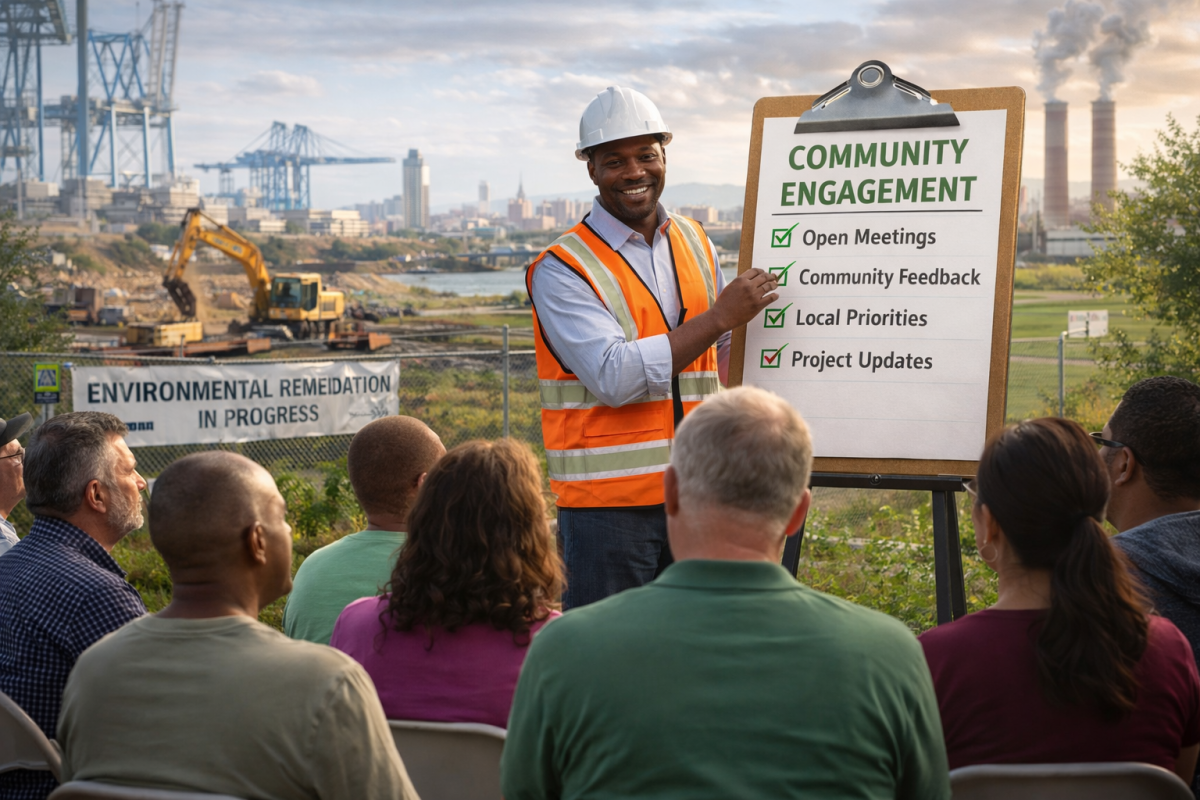
We engage early. During site assessment, before plans are finalized, we meet residents, local organizations, and sometimes even children, aiming to understand their concerns, hopes, and priority uses of the land. We hold open meetings, workshops, invite feedback, and incorporate that feedback into remediation planning.
We strive for clear communication, not in dense technical jargon but in plain language that the community can understand. We share findings, proposed options, trade-offs, and timelines. We welcome questions. We value transparency.
We build partnerships with local residents, civic groups, and possibly volunteer networks. We support capacity, helping community members understand monitoring tasks, providing training where possible, sharing tools, or building community-scientist collaborations.
And finally, we commit to long-term stewardship. Cleanup is not a one-off box checked, but a process that needs ongoing care, monitoring, maintenance, and a community that feels it is their land again.
Case Study: Oakland Army Base Redevelopment
The Port of Oakland’s remediation of the former Oakland Army Base required extensive engagement with West Oakland residents, who had long-standing environmental justice concerns about contamination and future land use.
Community Engagement Approach
The engagement strategy was structured around early, continuous, and measurable participation. Public outreach began approximately 18 months prior to remediation and included recurring monthly community meetings to provide project updates, gather feedback, and address concerns in real time. A formal Community Advisory Group was established to provide ongoing input on cleanup priorities and redevelopment outcomes. Workforce development initiatives were introduced to create local job training opportunities connected to remediation activities. All outreach materials and meetings were delivered in both English and Spanish to ensure broad accessibility and participation across the West Oakland community.
Results
- Project received strong community support despite complex contamination
- No CEQA lawsuits or permit challenges
- Remediation completed on schedule
- Community members became project advocates
Early, transparent engagement turned potential opposition into partnership.
Final Thoughts
For municipal agencies, remediation success depends on more than technical cleanup. It depends on trust, transparency, and early collaboration.
Projects that engage communities early move faster, face fewer legal challenges, and maintain stronger public and political support. Engagement transforms remediation from a technical task into a shared public investment.
Get municipal remediation and environmental consultation: Contact PEnterprise
Related Articles
Fast-Track Environmental Approvals for Commercial Projects
Maximizing ROI Through Strategic Site Remediation
Environmental Due Diligence Checklist for Developers
Article by: Pearl Hanks, MBA, Professional Geologist, Certified Hydrogeologist | CEO, PEnterprise Consulting Services
Pearl leads environmental due diligence, remediation, and regulatory strategy for complex redevelopment projects across California. With 15+ years of experience, rare triple-certification, and oversight of 500+ site investigations and cleanups, she specializes in helping developers reduce risk, accelerate approvals, and transform contaminated properties into high-value assets.